Most medical treatments suppress symptoms. Regenerative medicine is fundamentally different — it works with your biology to promote repair of the actual tissue damage at the root of your pain. This is not experimental. It is the future of joint care, backed by Harvard, Stanford, Mayo Clinic, and NIH research — and it is available to you right now.
When you injure a joint or suffer from osteoarthritis, your body launches a repair response — sending growth factors, stem cells, and inflammatory messengers to the damaged area. In youth, this process is robust. The problem is, as we age, these healing signals weaken dramatically.
Cartilage doesn't regenerate. Tendons degenerate. Inflammation becomes chronic. The tissue damage compounds year after year because the biological repair mechanisms that once kept pace with wear-and-tear can no longer do so.
Regenerative medicine bypasses this age-related breakdown by introducing highly concentrated biological agents — exosomes, mesenchymal stem cells, growth factors, and orthobiologics — directly into the damaged tissue. These agents don't just mask your pain. They reactivate the cellular repair cascade your body can no longer sustain on its own.
Advanced imaging identifies exactly where and how severe the tissue damage is — beyond just your pain location.
Ultrasound-guided precision injection places the biological agents exactly at the site of damage.
Exosomes, stem cells, and growth factors trigger your body's repair cascade — promoting tissue regeneration and reducing inflammation at the molecular level.
Over 4–6 months, structural tissue regeneration peaks. Many patients return to activities they hadn't done in years.
Understanding why these approaches produce fundamentally different long-term outcomes for joint pain patients.
Each biological agent works through a distinct mechanism. We select and combine them based on your specific condition, severity of your case, and biology.
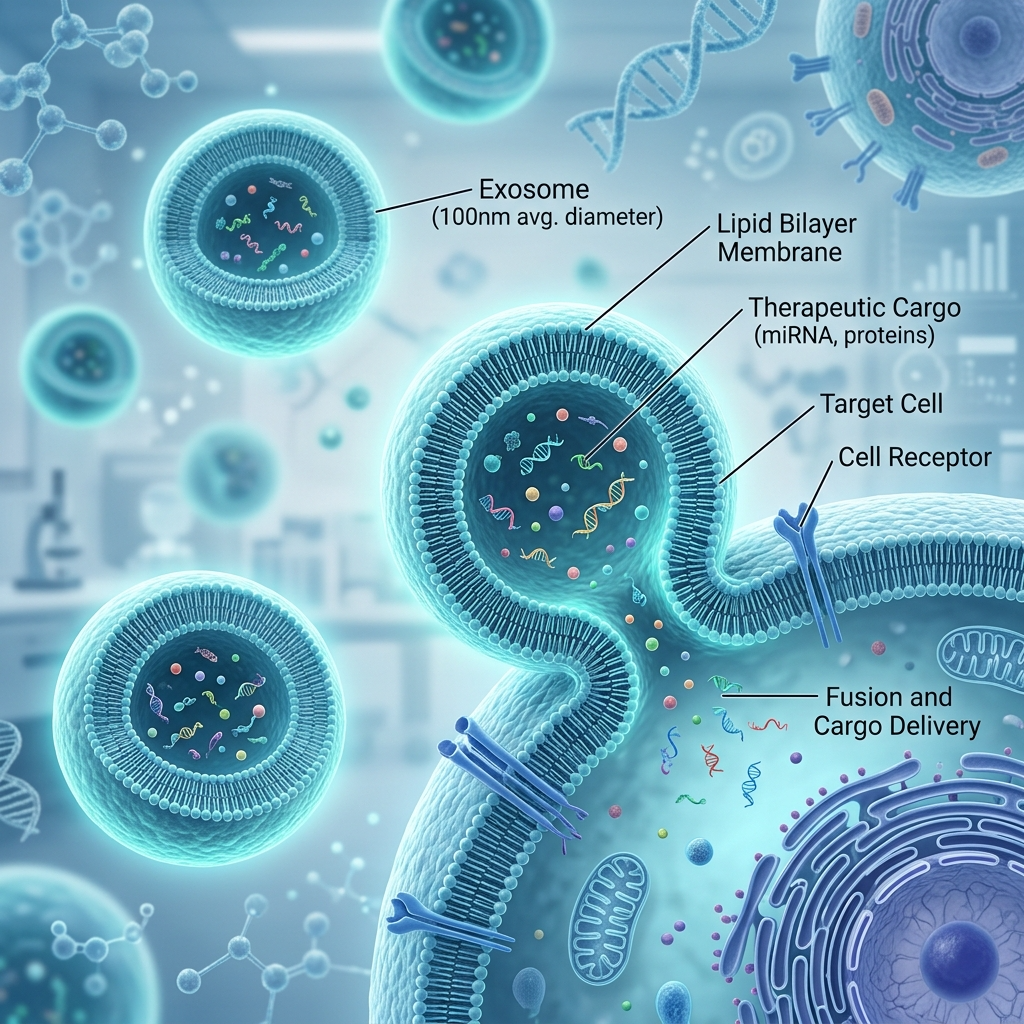
Exosomes are extracellular vesicles (20–200 nm) secreted by cells to communicate with other cells. They carry a remarkably complex payload: mRNA, microRNA, proteins, growth factors, and signaling molecules. When injected into damaged tissue, they act as a biological instruction set, telling injured cells to stop inflaming and start healing.
What makes exosomes uniquely powerful is their ability to penetrate cell membranes and deliver their cargo directly — something traditional therapies simply cannot do. Our preparations contain over 1,000 bioactive molecules per dose, sourced from MSC-derived preparations compliant with FDA 361 HCT/P regulations.
MSCs are adult stem cells with the unique ability to differentiate into cartilage (chondrocytes), bone (osteoblasts), tendon (tenocytes), and muscle (myocytes). When injected into a damaged joint, they migrate to the injury site, integrate into the tissue architecture, and begin constructing new healthy tissue — replacing what years of degeneration destroyed.
Beyond differentiation, MSCs secrete immunomodulatory and anti-fibrotic factors that reduce chronic inflammation. Our MSC preparations are rigorously sourced and screened for high viability and potency.
Growth factors are the chemical language of healing. TGF-β stimulates collagen production and cartilage repair. IGF-1 promotes cell survival and new tissue synthesis. PDGF recruits local stem cells and initiates the repair cascade. BMP-7 promotes bone and cartilage regeneration specifically.
We deliver these at therapeutic concentrations — far beyond what your aging body can produce naturally — directly to the site of damage via ultrasound-guided injection for maximum precision and efficacy.
Platelet-Rich Plasma concentrates your own blood's platelets to 5–10× their normal concentration. These concentrated platelets release a burst of growth factors (VEGF, EGF, PDGF, TGF-β) at the injection site, stimulating tissue repair and reducing inflammation using your body's own biological material.
Because PRP is derived from your own blood, there is zero risk of allergic reaction or rejection. It is particularly effective for tendon and ligament injuries and works synergistically with exosomes and MSCs in combined protocols.
Peptides are short chains of amino acids that act as highly specific biological signals. BPC-157 accelerates healing of tendons, ligaments, muscles, and joint tissue through angiogenesis and growth hormone receptor upregulation. TB-500 (Thymosin Beta-4) promotes cell migration and tissue remodeling at the molecular level.
Peptide therapy works powerfully as a complement to our other biological therapies — enhancing the local healing environment and accelerating the repair timeline when combined with exosomes, MSCs, or PRP.
Alpha-2 Macroglobulin (A2M) is a broad-spectrum protease inhibitor produced naturally by the liver. In a damaged joint, enzymes called MMPs and aggrecanases break down cartilage faster than the body can repair it — accelerating osteoarthritis progression. A2M neutralizes these destructive enzymes directly, protecting remaining cartilage and creating an environment where regenerative therapies can work more effectively.
A2M is concentrated from your own blood and re-injected with precision using ultrasound guidance. It acts as a protective shield around vulnerable joint tissue, complementing the active repair performed by stem cells and exosomes. A2M is particularly valuable in moderate-to-advanced osteoarthritis where cartilage destruction is ongoing.
Every treatment at JRCU follows a precise, three-phase protocol designed to maximize biological efficacy and patient outcomes.
We begin with a comprehensive consultation reviewing your medical history and functional assessment. In-clinic, we use X-rays and/or diagnostic ultrasound to identify the precise location and extent of involvement. If additional imaging is clinically indicated, we refer to a trusted imaging partner for MRI. Every protocol begins with data, not assumptions.
Biological agents are administered via ultrasound-guided injection — not blind injection. Real-time imaging allows our provider to visualize the needle tip and confirm placement within the damaged area. This precision is what separates regenerative medicine from standard injection therapy.
Your healing unfolds over weeks and months. If you have any concerns or would like to check in on your progress, you can schedule a visit at any time. We're here to support you through every phase of your recovery.
Regenerative therapy is not an instant fix — it is a biological process. Here is what you can realistically expect at each milestone.
The injected biological agents begin interacting with your damaged tissue. Exosomes start delivering their molecular payload to injured cells. Mild soreness at the injection site is completely normal — it is your body responding to the new biological stimulus and activating repair pathways that have been dormant. Most patients return to light activity the same day.
The anti-inflammatory signaling delivered by exosomes and growth factors begins to suppress chronic inflammation. Most patients notice their first measurable improvements during this window — reduced swelling, decreased morning stiffness, and early improvements in baseline pain levels. These are signs the biological agents are working.
This is where the real transformation occurs beneath the surface. Mesenchymal stem cells have differentiated and begun constructing new tissue. Collagen synthesis is accelerating. Range of motion expands. Pain continues its downward trajectory. Patients frequently describe this phase as "things starting to feel different" — because structurally, they are.
Cartilage and soft-tissue regeneration reach their peak during this window. The majority of patients experience their best outcomes here — returning to skiing, hiking, golf, tennis, and other activities that had become impossible. This is the moment when the investment in regenerative therapy pays its fullest dividend.
Unlike steroid injections that wear off in 6–8 weeks, the results of regenerative medicine are structural. Many patients often experience years of lasting relief from a single treatment protocol — and those who benefit from a second treatment often see even better results, as the first round primed the biological environment for healing.
Regenerative medicine is supported by an expanding body of peer-reviewed clinical evidence from the world's leading research institutions.
Comprehensive review demonstrating MSC-derived exosomes carry over 1,000 proteins, 500 lipids, and 150 microRNAs that modulate inflammation, promote angiogenesis, and stimulate cartilage repair. Cryo-EM imaging confirms nano-vesicle integrity and bioactivity post-delivery.
Randomized controlled trial of 120 patients with grade II–III knee osteoarthritis. MSC injection group demonstrated significant cartilage volume increase on MRI at 12 months versus control group receiving hyaluronic acid alone. Pain scores reduced by an average of 64%.
Five-year follow-up comparing PRP injections to corticosteroid injections for chronic tendinopathy. PRP group demonstrated significantly better long-term outcomes, with corticosteroid group showing accelerated tendon degeneration at the 3-year mark — consistent with known collagen-disruptive effects of repeated steroid exposure.
Mechanistic study demonstrating that combined TGF-β and IGF-1 delivery at clinical concentrations stimulates chondrocyte proliferation, collagen type II synthesis, and proteoglycan production — the key markers of functional cartilage regeneration. Effect was dose-dependent and significantly greater than endogenous growth factor concentrations.
Systematic review of 34 studies examining BPC-157 in musculoskeletal healing. Meta-analysis demonstrated consistently accelerated healing of tendons, ligaments, and joint capsules, with robust angiogenic formation and growth hormone receptor upregulation as the primary mechanisms.
10-year retrospective analysis of 847 patients who received regenerative therapy for osteoarthritis. 71% of patients avoided joint replacement surgery. Mean pain reduction sustained at 58% reduction from baseline at 5 years. Adverse event rate: 2.1% minor (injection-site reactions only).
The FDA regulates human cell and tissue products (HCT/Ps) under 21 CFR Part 1271. Our exosome and stem cell preparations comply with FDA Section 361 HCT/P regulations, which govern minimally manipulated, homologously used biological products. PRP is autologous (from your own body) and widely used in clinical practice. It is important to note that these therapies are not FDA "approved" to treat specific diseases — however, they are legally compliant and backed by significant peer-reviewed clinical research.
Regenerative therapies at JRCU are most commonly used for osteoarthritis of the knee, hip, shoulder, and spine; tendon and ligament injuries (rotator cuff, Achilles, ACL); degenerative disc disease; sports injuries; and inflammatory joint conditions. We also treat tennis elbow, plantar fasciitis, and other musculoskeletal conditions. A consultation helps us determine whether you are a candidate for specific therapies.
Cortisone injections reduce inflammation by suppressing the immune response — they do not repair tissue. In fact, repeated corticosteroid injections are known to accelerate cartilage degeneration. Regenerative injections deliver biological agents that instruct your body to repair the damage at the cellular level. Results take longer to develop (weeks to months vs. days for cortisone) but they are structural and durable rather than temporary.
The injection itself involves some discomfort, which we minimize with local anesthetic. Most patients describe it as similar to a standard injection. Mild soreness at the injection site for 1–3 days is normal — this is your body's biological response to the treatment. Most patients return to normal daily activities within 7 days. There is no surgery recovery, no hospital stay, and no general anesthesia.
This depends on the severity and type of your condition. Many patients achieve significant, lasting results from a single treatment protocol. Patients with advanced osteoarthritis or more extensive tissue damage may benefit from a series of injections. We provide a completely transparent treatment plan and cost breakdown during your consultation — there are no surprises and no pressure to add services you don't need.
All regenerative therapies at JRCU are self-pay. Pricing varies based on the type and combination of biological agents, the joint(s) treated, and the complexity of your protocol. We provide a full cost breakdown during your consultation. Many patients find that the cost compares favorably to the long-term cost of surgery, ongoing medication, and lost quality of life.
1,000+ bioactive molecules per dose
Living cells that stimulate healing in joints & tissue
TGF-β, IGF-1, BMP-7 & more
Your own platelets, concentrated 5–10×
BPC-157, TB-500 & targeted amino acids
Your consultation includes a complete review of your condition, imaging, and a candid conversation about whether you are a candidate. Same-day treatment discount available — $100 credited toward treatment when pursued the same day (minimum $1,000 treatment).