What Are Exosomes? A Plain-English Guide for Patients
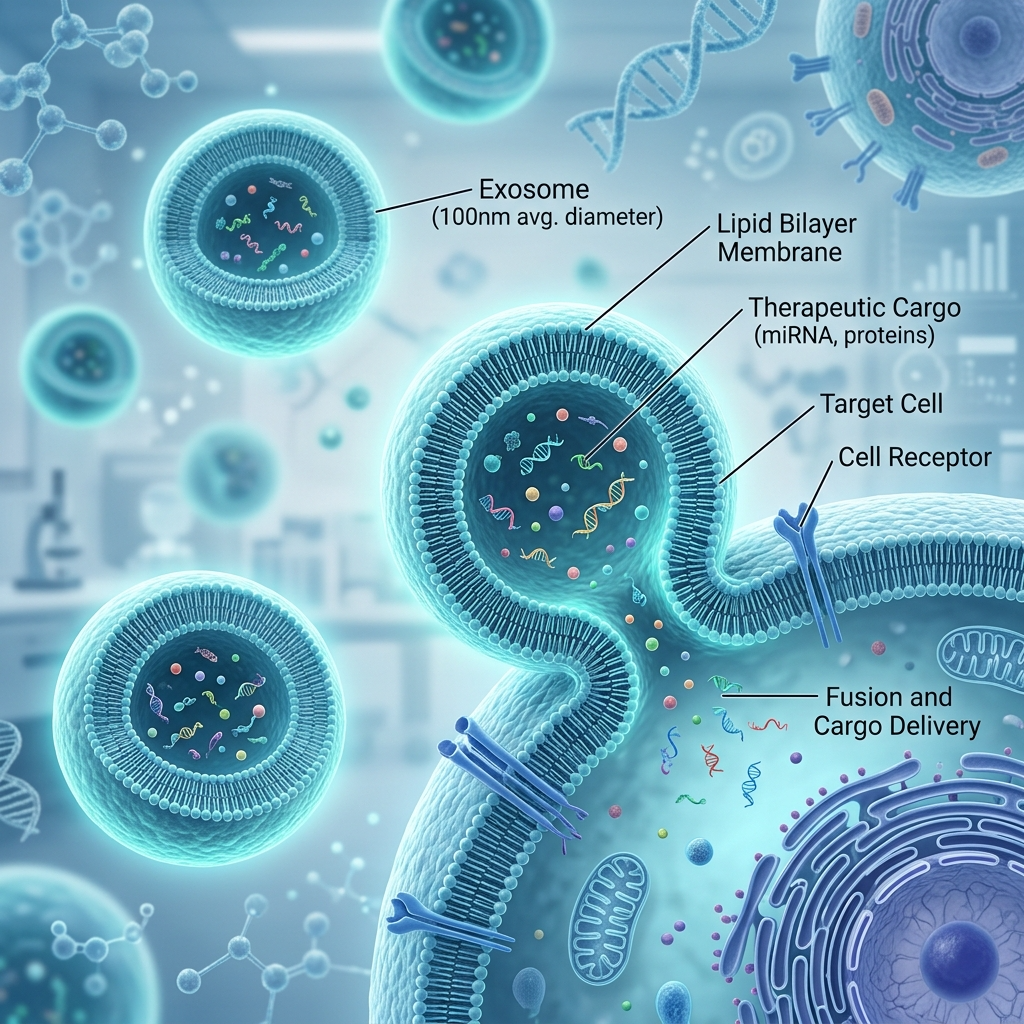
Exosomes are one of the most exciting developments in regenerative medicine — but the explanations out there range from incomprehensible science jargon to vague marketing claims. This article is neither. It's a straightforward, honest guide to what exosomes actually are, how they work for joint conditions, and what you should realistically expect.
What Is an Exosome?
Every cell in your body communicates with neighboring cells. One of the primary ways it does this is by releasing tiny packets of biological information — called extracellular vesicles. Exosomes are the smallest of these vesicles, measuring just 30–150 nanometers (for context, a human hair is about 80,000 nanometers wide).
Inside each exosome is a cargo of:
- Growth factors — proteins that signal tissue repair
- MicroRNAs — gene expression regulators that turn cellular repair programs on or off
- Anti-inflammatory cytokines — molecules that suppress the chronic inflammation driving joint breakdown
- Proteins — structural and signaling molecules for tissue maintenance
Think of exosomes as text messages between cells — carrying specific instructions about what to do, where, and when.
Key insight: Exosomes don't become cells. They don't replicate or grow. They deliver biological instructions — and those instructions tell your body's own cells to initiate repair, reduce inflammation, and stimulate healing in damaged tissue.
Where Do the Exosomes Used in Treatment Come From?
The exosomes used in clinical treatment are typically derived from mesenchymal stem cells (MSCs) — the same stem cells that form cartilage, bone, and connective tissue. Specifically, they're most often sourced from:
- Amniotic fluid or birth tissue sources — ethically sourced from consenting donors
- Bone marrow-derived MSCs
- Adipose (fat) tissue-derived MSCs
The MSCs are cultured in a laboratory, and the exosomes they secrete are harvested, purified, and concentrated. The result is a preparation containing hundreds of millions — sometimes billions — of exosomes per dose.
How Do Exosomes Treat Joint Conditions?
Joint degeneration — whether in the knee, hip, or spine — involves two interrelated problems:
- Chronic inflammation — elevated levels of destructive cytokines that eat away at cartilage and sensitize pain receptors
- Impaired repair — chondrocytes (cartilage cells) and synovial cells lose their ability to regenerate with age and injury
Exosomes address both simultaneously. When injected into a damaged joint:
- Anti-inflammatory cargo suppresses destructive cytokine activity
- Growth factors activate resting chondrocytes and synovial cells
- MicroRNA packages reprogram cell behavior toward repair rather than degradation
- The overall joint environment shifts from destructive to regenerative
Exosomes vs. Stem Cell Therapy: What's the Difference?
Patients often ask whether they should choose exosome therapy or stem cell therapy. Here's the honest comparison:
- Stem cells are living cells that can potentially differentiate into cartilage, bone, or connective tissue — providing structural repair. They are a longer-acting, more structurally focused therapy.
- Exosomes are not living cells — they cannot differentiate or multiply. Their power lies in the density of signaling molecules they deliver. They often produce faster initial results and can be used in patients who are not ideal stem cell candidates.
- Combined protocols — using both in sequence — are often the most powerful approach for moderate-to-severe joint degeneration.
What the Research Shows
Exosome therapy for musculoskeletal conditions is an emerging but growing evidence base. Published research has demonstrated:
- Significant reduction in OA-related pain and functional limitation scores
- Cartilage cell proliferation and proteoglycan synthesis in preclinical models
- Suppression of pro-inflammatory cytokines including IL-1β and TNF-α
- Improved joint space on follow-up imaging in clinical case series
It's important to note: exosome therapy is not FDA-approved to treat any specific condition. This is an evolving field — one with substantial promise and early evidence, but not yet the depth of clinical trial data that established surgical interventions have accumulated over decades.
Our position: We believe the evidence base for exosome therapy in joint conditions is compelling and growing. We also believe patients deserve an honest conversation about what the research shows — and what it doesn't yet show. That's what your consultation is for.
What to Expect from Exosome Treatment
Here's a realistic timeline for patients pursuing exosome therapy at JRCU:
- Days 1–14: The anti-inflammatory effect begins. Many patients notice reduced swelling and pain severity in the first two weeks.
- Weeks 2–8: Cellular signaling peaks. The repair cascade is active — though not yet fully visible in function or imaging.
- Months 2–6: Structural improvement accumulates. Cartilage cell activity increases. Most patients report progressive, continued improvement.
- 6+ months: Full biological response. Follow-up imaging can confirm tissue changes.
Am I a Candidate?
Exosome therapy is appropriate for many — but not all — patients with joint degeneration. Strong candidates typically have:
- Osteoarthritis Grade I–III (or equivalent in other joints)
- Joint pain that has not been adequately resolved by physical therapy or cortisone
- A desire to avoid or delay surgical intervention
- Reasonable joint alignment (severe structural deformity reduces efficacy)
The best way to determine candidacy is a proper consultation — including a review of your current imaging and a candid conversation about your goals. Same-day treatment discount available — $100 credited toward treatment when pursued the same day (minimum $1,000 treatment).
Ready to Find Out If You're a Candidate?
Book a consultation — our providers personally review every case and give you an honest answer about what regenerative therapy can do for your specific condition. Same-day treatment discount available — $100 credited toward treatment when pursued the same day (minimum $1,000 treatment).
Book My Consultation